By Wang Ye
Founding teacher of Centrigrowth Culture Ambassador Lab and
Board Member of Washington State Chinese Teachers Association(CLTA-WA)
On January 11, 2025, Seattle hosted a unique celebration of Chinese American History Month in Washington. The documentary screening and culture identity event, co-hosted by Centrigrowth, a local Seattle education organization, and Little Masters Club, a non-profit organization for youth, attracted nearly a hundred participants from diverse cultural backgrounds. That afternoon, the Bellevue Library auditorium was packed, filled with a warm and lively atmosphere.

“One-Mile Walk” Screening:
A Lens into the Resilience of Chinese American Heroes
We were honored to invite award-winning California journalist and documentary filmmaker Min Zhou to Seattle to engage with the audience. Her documentaries focus on telling the stories of Chinese Americans and Asian immigrants, bringing forgotten history back to life.
As “One-Mile Walk” began, the auditorium gradually quieted down. In the film, Gerry’s husband and friends recounted her journey to fight for the rights of Chinese Americans, and each scene deeply moved everyone present. When Gerry’s husband talked about how, through her efforts, the Pacific Grove city government finally issued an official apology, many people had tears in their eyes. After the film, the audience burst into applause, cheering for Gerry, the resilient “warrior,” and thanking Director Zhou for her heartfelt portrayal of this history.
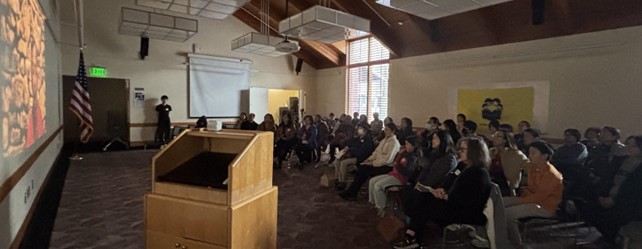
Richard Hao, a history-loving teenager, was deeply drawn to this story. He asked Director Zhou how she came across these materials and decided to make this film. Director Zhou replied, “I met Gerry at an event in Palo Alto and was very moved by her story. I felt it was a kind of fate. Later, when I suddenly heard the news of her passing, I felt that I owed her a precious record, and that’s how this documentary came about.”

Knowledge into Action:
Understanding and Inheriting History, Guarding and Practicing Together
Betty Lau, a local Seattle Chinese American community activist, was invited to attend the event. She eloquently shared the efforts she and her companions had made to protect Seattle’s Chinatown, winning warm applause.
An audience member asked, “What can we do to support the community?” Ms. Lau smiled and replied, “That’s a great question! We need to not only learn about objective history but also learn from the examples around us.” She urged everyone to proactively learn about the current situation and challenges facing Seattle’s Chinatown and take action when appropriate.

Additionally, she encouraged Chinese American youth to participate in both in-school and out-of-school activities, learn about Chinese American history and culture, and explore their identities.

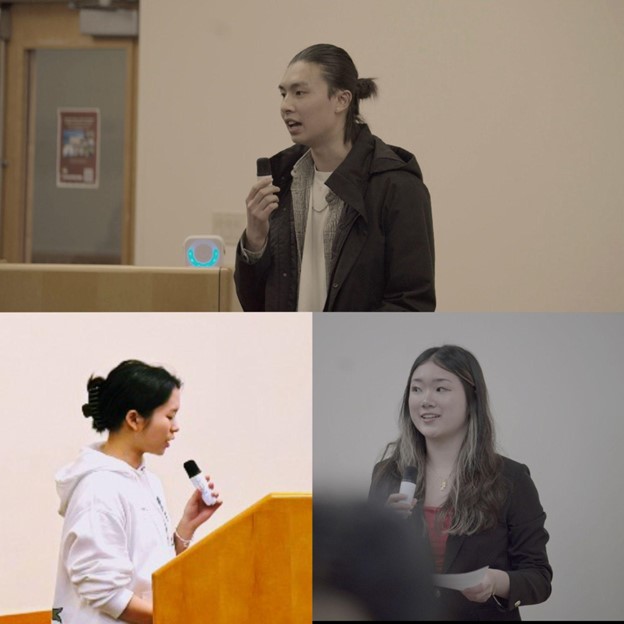
Subsequently, youth representatives from the University of Washington, Skyline High School, and Little Masters Club shared their community practice experiences in fluent English. Their confidence and enthusiasm infected everyone present and brought much hope.
Fostering Exchange:
New Opportunities for Co-creation in Brainstorming
Bridget Yaden, Executive Director of the Pacific Northwest Language Council for Languages (PNCFL) said, “Such events are of great significance for promoting intercultural exchange. We should work together to create a more diverse and inclusive society for the next generation.” She also mentioned that she had recently led students in writing and submitting Senate Bill 5134, aimed at enhancing the implementation of Senate Bill 5000, encouraging and eventually requiring public schools to commemorate the contributions of Chinese Americans and Americans of Chinese descent. She called on all sectors to actively participate in hearings and share their views.

Mo Xiaoling, president of the Washington State Chinese Teachers Association (CLTA-WA), said that the association held an online seminar during Chinese American History Month in 2024, inviting experts in the field to discuss teaching strategies and compiling teaching resources related to Chinese American history and identity for teachers and the Chinese community to use this year. In the future, CLTA-WA will continue to encourage teachers to collaborate with colleagues in language arts and sociology, as well as the broader community, to ensure that this important historical and cultural heritage is passed down from generation to generation.
Sun Burford, Newcastle City Council’s first Chinese American council member, expressed her satisfaction with everyone’s interest in Chinese American history and identity, believing that this reflected the community’s diversity and inclusiveness. She hoped that more Chinese American youth would play a role in community activities. Zhu Run, Bellevue City Government’s cultural outreach specialist, gave positive feedback on the event and encouraged all Chinese American participants and youth to use their respective energies to contribute to community building and maintenance.
Although time was limited, representatives from Seattle United Hub, Caca, and other organizations, as well as individual participants, also spoke to express their learnings and future action plans. The on-site interaction and communication atmosphere was very enthusiastic. Everyone agreed that this event not only increased their understanding of Chinese American history but also strengthened the community’s cohesion and sense of identity.

A group photo of our event organizers, a represent of co-sponsors, and our cultural official (L to R: Faye from CACA; Li Chen from Little Masters Club; Director Min Zhou (Susan) from California; Ye Wang (Cheryl) from Centrigrowth; Run Zhu from Bellevue City)
Looking Forward:
Building a Diverse, Inclusive, and Collaborative Community
To continue the significance of this event, we can consider gradually taking the following actions:
- Establishing Chinese American history archives: Collect, organize, and preserve Chinese American historical materials, recording and passing on the contributions and stories of Chinese Americans to provide convenience for future research.
- Developing in-depth language and cultural teaching: Encourage Chinese language and culture teachers to exchange and collaborate with each other, develop multicultural themed courses, understand students’ identity needs, and motivate them to actively participate in community activities to promote intercultural exchange and understanding.
- Popularizing community volunteer service: Encourage everyone to participate in volunteer service projects in families, schools, and communities, proactively understand and participate in community service, give back to the community, and enhance community cohesion and a sense of responsibility.
- Supporting and organizing cultural festivals and history remembrance events: Supporting and organizing cultural festivals and history remembrance events involves hosting and participating in activities that highlight the objective value and unique characteristics of different historical cultures. These events aim to celebrate and commemorate the diversity of historical cultures and promote community awareness by bringing together people from various backgrounds.
- Encouraging youth intercultural exchange: Encourage youth to organize or participate in exchanges and learning with different cultural backgrounds, increase understanding and cooperation, help youth understand objective history and identity, and independently choose the cultural identity and sense of belonging that best suits them. Through these actions, we can work together to contribute to community building and cultural heritage, and create a more diverse, inclusive, and beautiful future.
Conclusion:
The Echo of History, the Hope of the Future
This event is not only a cultural feast but also an act of community building. It satisfies people’s desire to understand Chinese American history and inspires everyone’s vision for the future of community building and cooperation. We believe that through continued efforts, the Chinese American community, with the support of a wider and more diverse community, will jointly write a more glorious chapter, since “WE ARE NOT ALONE!”
Feedback from our Participants:
“History is repeating with Sound Transit’s attempt to wipe out Chinatown. Chinese labor in Newcastle’s coal mines powered Seattle’s rise to an international port city.
Research shows that strong cultural identities lead to better educational outcomes and future success. An OCA intern and a college friend both struggled with self-hatred due to racial identity, highlighting the need for cultural engagement.
I encouraged Asian youth, especially multi-racial youth, to join Asian activities in and outside of school. I started lion dance teams, cultural dancing for girls, and advised Chinese and Asian Student Clubs to foster knowledge and pride.
Asian boys became Dragon Team Runners, earning respect. Former Governor Gary Locke was a dragon boy, and his sisters were in the Chinese Girls Drill Team, where they developed teamwork and leadership skills. Cheryl Chow, a drill team member, became the first Chinese American woman on the Seattle city council.
The pride and skills from participating in these activities are immeasurable.”
—— Betty Lau Teacher Education Specialist & CLTA WA Advisor
“All students should learn the history of Chinese Americans in Washington State, in order to understand and celebrate their many contributions to our communities. We must learn the dark side of that history and the racist and xenophobic acts that they suffered, in order that history does not continue to repeat itself. I was born, raised, and schooled in Tacoma. The first I learned of the Chinese Exclusion Act was as an adult during a visit to Ellis Island in NY, where I saw an artifact named Tacoma. I had never heard of it during my time as a student in K-12 or college. Documentaries, novels, museums, monuments, and other resources are wonderful ways to engage in this important history.
If community members are interested, they can advocate for and provide input on current Washington State SB 5134 – which would require public schools to commemorate the contributions of Chinese Americans and Americans of Chinese descent. ”
—— Bridget Yaden, PhD Associate Provost, Pacific Lutheran University & Executive Director, Pacific Northwest Council for Languages
“This event was deeply moving and life changing. The significance and importance of this event wasn’t just for the Chinese community, but for humanity in general. Hearing from the voices of vastly different generations, yet all sharing the same message of hope, was truly inspirational.
It was both fascinating and encouraging to discover the similarities of the Chinese American experience to my own Mexican American experience.
I walked away with a renewed passion, and sense of urgency, to see continued and future solidarity work happen across different communities in our area and around the world. This event was a call to action… and I can’t wait to see what comes next.”
—— Juan Esparza Outreach Specialist & Adjunct Professor at Bellevue College
“Thank you for inviting me to this wonderful event and giving me the chance to share my perspectives as a K-12 student. I learned so much about Chinese-American history, especially about the burning of a village in California—something new to me.
The progress in DEI and social justice is thanks to the efforts of Chinese-American leaders who have fought for decades. Let’s amplify our youth voices, take impactful actions in our daily lives, and support bills and legislators.
I also had the opportunity to hear from representatives of nonprofit organizations, and I hope to collaborate with them to uplift our community.
Thanks again to the event organizers. I hope to return next year with more fellow students.”
—— Natalie Cui Skyline High School student & Competition Committee Chair 2025 “Why We Learn Chinese” Competition
“This event in collaboration with Centrigrowth and the Little Masters Club not only gave me an opportunity to fully showcase my work and ideas of the documentary ‘One-Mile Walk’ and other documentaries, but also made me feel the deep concern and support of the Seattle community for Chinese American history. The enthusiastic feedback and deeply moved expressions of the audience made me realize the significance of telling these forgotten stories. This history is not only Gerry’s personal experience but also a testament to the collective struggle of the entire Chinese American community.
This event has given me new inspirations and visions for collaboration. I hope to continue to explore and document the history and contributions of Chinese Americans in Seattle with the help of local high school volunteers. For example, in the future, we could film a documentary about Ms. Betty Lau and other Chinese Americans who fought to protect Chinatown. This would not only be a record of history but also an inspiration for the future.
In combination with community activities, such as the upcoming commemorative walk from Chinatown to the harbor, we can conduct more interviews and filming to capture the true voices and stories of the community. I believe that through our joint efforts, we can produce a historic documentary that will become part of the curriculum, educating and inspiring future generations.”
—— Min Zhou Journalist at YouTV in the San Francisco Bay Area & California Director of Chinese American History Documentaries
“The United States is a typical immigrant country. Objectively speaking, it has a tradition of accepting and embracing various ethnic groups since World War II. For half a century, Chinese people residing and traveling in the U.S., as a minority, have taken root, propagated, and grown on this land. We are not only proud of our five thousand years of Chinese heritage but also should make the world aware of the contributions Chinese people have made to the development of the U.S. and the injustices they have faced.
Our exceptionally talented director Min Zhou from California traveled extensively and conducted numerous interviews to gather information and uncover little-known histories of Chinese Americans. Her meticulously crafted documentary, “One-Mile Walk” brought Seattle audiences closer to history, revealing truths and evoking profound emotions.
Although the screening and discussion session has ended, as a Chinese immigrant family and as a mother of two, this special gathering prompted me to ponder more: What can we do to promote Sino-American friendship? How can we learn from history to avoid repeating mistakes? How can we ensure our community and the next generation understand this history? I believe this is the original intention behind Wang Laoshi from Centrigrowh and Little Masters Club’s collaboration to organize and facilitate this event. I look forward to more of Director Zhou’s exceptional works in the future!”
—— Isabel Liu A Parent from Centrigrowth Culture Ambassador Lab (Novice Class)